Would You Rather Choose?
- 4.1
- Rating
- 500.00K
- Installs
- Free
- Price

 Analysis by App-foxy
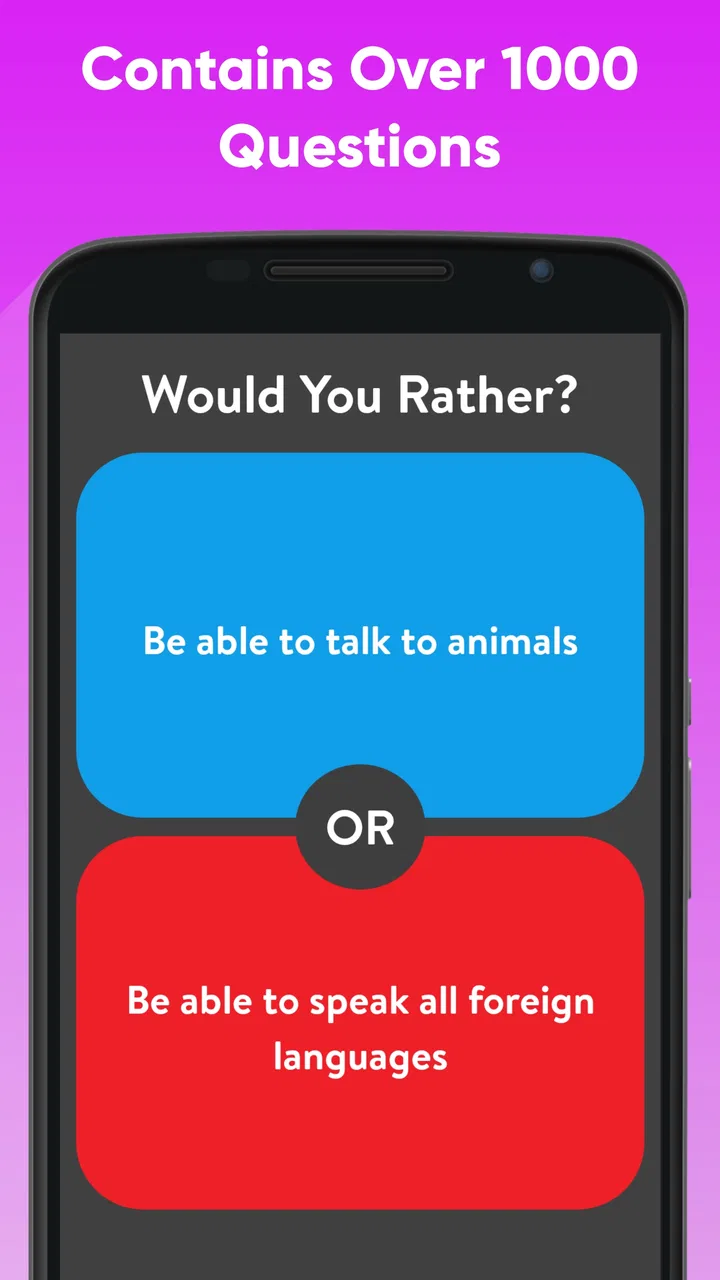
I picked up Would You Rather Choose? expecting a quick conversation starter, and that is exactly where it works best. It is a free trivia game from KDR Games built around “would you rather” choices, so the entertainment comes from answering awkward, funny, or revealing questions with other people. I found it much more enjoyable as a shared activity than as something to play alone for a long stretch.
The basic idea is familiar, but the mobile format makes it easy to put into a casual setting. You can use it when friends are sitting around with nothing planned, during a family gathering where conversation has slowed down, or as a low-effort party activity that does not require cards, a board, or a complicated explanation. The game has a Teen content rating, which is important because some choices may suit older teenagers and adults better than younger children.
It is currently free to download, with optional in-app purchases listed at $1.49 to $2.99 per item. That makes the initial decision simple: there is no purchase required just to try the game. Still, I would keep the spending question in mind if you are considering it for repeated group use, especially because the value depends less on long-term progression and more on whether the available questions stay fresh for your group.
You May Also Like

 Blood Strike: 2.5 Anniversary
Blood Strike’s Loadouts Turn Every Drop Into a Tactical Gamble
A close look at Blood Strike’s custom loadouts: how fast access to signature weapons reshapes its battle royale rhythm, rewards preparation, and narrows the gap between fights.

 Pandora - Music & Podcasts
Pandora’s Music Is Easy to Start, but Harder to Recover
Pandora’s strength is its low-effort path from a seed to a station. Its weak spot is how much confidence it asks you to place in connection, setup, and quiet recovery.

 8 Ball Pool
 Is Built on Rivalries, Rematches, and Routine
A close look at the rivalries, rematches, shared routines, and unanswered safety questions that turn a quick pool match into a persistent mobile community.

 Samsung Music
’s Quiet Strength Is Playing What You Already Own
Its reach comes less from spectacle than from dependable access to a personal library. That simplicity is both the app’s strongest retention engine and its ceiling.

 AccuWeather: Weather Radar
AccuWeather Review: A Quick, Clear Forecast for Everyday Decisions
For everyday plans, the best forecast is the one you can understand quickly. AccuWeather makes rain timing, radar, and local conditions easy to act on, with a few trade-offs.

 Hill Climb Racing
Why Hill Climb Racing Still Turns Crashes Into One More Run
A tiny car, a bumpy hill and one more upgrade: Hill Climb Racing keeps resurfacing because its simple chaos makes every near-miss feel personal.
More From Our News Desk
View All News


How the question format works in a real group
My first useful observation is that the app is not really competing with deep trivia games. There is no need to memorize facts or build a specialist knowledge base. Instead, it creates a prompt, and the group reacts. That changes the role of the person holding the phone: they are not simply playing against a computer, but helping keep a conversation moving.
A good way to use it is to establish a simple rotation before starting. One person reads the question aloud, everyone answers, and the phone moves to the next person. This avoids the common problem where one player becomes the permanent host while everyone else waits. It also makes the game feel less like a private mobile session and more like a shared activity.
I would not hand the phone around randomly if the group is large. That can interrupt the rhythm, particularly when people are already talking over one another. A better approach is to let one person read several prompts while another keeps track of whose turn it is. This small change makes the experience noticeably smoother without requiring any extra equipment.
The strongest moments come from questions where neither answer is obviously comfortable. If one option is clearly preferable, the group tends to answer quickly and move on. When both choices have a cost, people explain themselves, challenge each other, and sometimes reveal surprising preferences. That is where the game becomes more than a sequence of taps.
There is also a useful social distinction between a close group and a group of acquaintances. With close friends, uncomfortable choices can become funny because everyone understands the tone. With newer acquaintances, the same question may feel too personal or simply fall flat. I recommend agreeing early that anyone can skip a prompt without having to justify the decision. That keeps the game playful instead of turning it into pressure.
Why the audience matters more than the score
Unlike a conventional quiz, this game does not depend on a correct answer. That means the group itself supplies most of the energy. If everyone is tired, distracted, or unwilling to explain their choices, the app can feel thin. If the group is talkative, even a simple prompt can lead to a long debate.
This is also why I would not judge it by the same standard as a fact-based trivia title. A traditional quiz can reward learning, accuracy, and improvement. Here, the reward is conversation. It is closer to a digital prompt deck than a knowledge test, even though it sits in the trivia category.
For a small gathering, I found that the best rhythm was to answer quickly first and explain afterward. If every person gives a long speech before the next prompt appears, the game loses momentum. On the other hand, if nobody explains anything, it becomes repetitive. Asking one follow-up question after each round—“Why that choice?” or “Would your answer change for a different person?”—adds depth without making the session feel formal.
A realistic everyday use would be a quiet evening with three friends waiting for food to arrive. Rather than opening separate social feeds, one person can start a round and let each choice fill the waiting time. The app does not need a setup period or a detailed rulebook, so it fits that kind of gap well. I would not expect it to carry an entire evening by itself, but it can give the first part of the gathering a clear starting point.
Managing progress without creating pressure
One thing I noticed is that this type of game works best when you do not treat completion as the objective. There is no reason to rush through prompts simply to reach an endpoint. If the group is enjoying a debate, stopping to discuss it is more valuable than immediately moving to the next question.
That makes the app a poor fit for anyone looking for a strong progression system. Players who want unlockable challenges, strategic decisions, personal records, or a campaign-like structure should look toward a different kind of trivia game. This experience is built around the moment, not around building a profile of achievements.
There can still be a subtle pressure in group play. Some people may feel they have to choose quickly, match the majority, or give an entertaining answer. I found that the easiest solution is to make the host read both options neutrally and avoid commenting before everyone answers. If the first person jokes about one choice, later players may simply follow that reaction rather than giving an honest answer.
For a more balanced round, have everyone answer at the same time by pointing left or right, raising a hand, or saying the option together. Only afterward should people explain. This keeps the loudest participant from setting the direction for everyone else and gives quieter players a fair chance to participate.
The free entry point is helpful here because it lets a group test the format before spending anything. I would use several short sessions rather than buying anything immediately. If your friends enjoy the discussions and ask to play again, optional purchases may be worth considering within the listed price range. If the group loses interest after a handful of questions, spending more would not solve the underlying problem.
Fairness when there is no right answer
Competitive fairness is unusual in Would You Rather Choose? because the game is not built around factual correctness. Nobody can win by knowing more than everyone else. That is a strength for mixed groups: a person who dislikes traditional quizzes is not automatically disadvantaged, and players do not need the same background knowledge.
At the same time, the lack of correct answers means the app does not provide a natural competitive structure on its own. If your group wants a winner, you will need to agree on a rule. You could award a point when someone persuades the group, when a minority answer receives the most interesting explanation, or when everyone predicts another player’s choice correctly. Those are house rules rather than a reason to assume the app includes a formal scoring system.
I prefer not to force a winner. Turning every answer into a contest can make personal questions feel like performance tests. The game is fairer when the aim is to compare reactions, not to prove that one preference is superior. If your friends enjoy friendly rivalry, use a light scoring method and reset it each session so one person does not dominate through familiarity.
Another fairness issue is the role of the reader. The person holding the phone controls the pace and may unintentionally skip questions they dislike or linger on choices that favor their own argument. Rotating the reader helps, but it also gives everyone responsibility for keeping the tone comfortable. I would treat the phone as a shared tool rather than a private advantage.
The Teen rating should also shape how you organize a mixed-age group. I would avoid assuming that every question is suitable for children simply because the game is easy to understand. For younger players, parents or hosts should decide whether the content fits the group before starting. In an adult gathering, the rating is less of a concern, but it still supports setting a boundary around personal or uncomfortable topics.
Spending, value, and the limits of what can be judged
The financial arrangement is straightforward enough to understand: the game is free, while individual in-app purchases are listed between $1.49 and $2.99. I appreciate being able to try the central idea without paying first. For a party game used occasionally, that lowers the risk of downloading it and discovering that the format is not right for your friends.
The harder question is whether optional purchases improve the experience enough for your particular group. That depends on how often you play and how quickly familiar prompts become predictable. I would not buy anything just because the app has become part of one successful evening. I would first see whether your group returns to it naturally and whether the available content still produces genuine discussion.
It is also worth separating convenience from value. A paid physical card game may offer a more tangible group experience, while a free mobile app is easier to carry and start immediately. A standard trivia app may offer clearer scoring and more replayable knowledge challenges. A random conversation-prompt tool may feel more relaxed if you want discussion without any sense of competition. This game sits between those alternatives: more structured than an open conversation, but less competitive than a quiz.
I would skip it if your main requirement is transparent competitive measurement. Since the appeal comes from personal choices rather than correct answers, it will not satisfy someone who wants rankings, detailed performance feedback, or a clear path to mastery. I would also skip it for a group that dislikes personal questions or prefers games with a definite winner.
On the other hand, it is a sensible choice when you need something quick, inexpensive to try, and easy to explain. The free price makes it especially practical for a host who wants a backup activity without buying a physical game in advance. Just remember that the app cannot manufacture chemistry between people who are not in the mood to talk.
What I would check before making it a regular party game
The app’s current version is 11.0.0, and it requires Android 7.0 or later. That gives Android users a clear compatibility point to check before installing. If your phone meets that requirement, the practical test is less about technical ambition and more about whether the question style suits your group.
I would also pay attention to how the game feels after the novelty wears off. The first session benefits from curiosity: people want to see what kind of choices appear and how friends respond. Later sessions need enough variety to avoid predictable answers. Rather than assuming every prompt will work for every audience, I would use the game selectively and stop while the conversation is still lively.
There is a useful hosting workflow here. Start with a few harmless questions, watch how comfortable everyone seems, and only continue into more personal territory if the group is clearly enjoying it. Do not use the app as a way to corner someone into revealing an opinion. A skipped question should be treated as a normal part of the session, not as evidence that someone is being difficult.
For remote play, I would be more cautious. The game can provide prompts during a voice or video call, but the social timing becomes harder because people may speak at once or miss reactions. In person, facial expressions and quick replies carry much of the entertainment. If you use it remotely, have one person read the prompt and ask everyone to answer in a fixed order.
These small procedures are not built-in features; they are ways I found to get more from the format. They matter because the app is deliberately simple. Its success depends on the people using it, the pace of the session, and the boundaries the host sets.
Who will enjoy it, and who should choose something else
I would recommend this game to friends who enjoy playful arguments, hypothetical situations, and learning how people think. It is particularly suitable for a small social group that wants an activity without a long explanation. It can also help break an awkward silence because every prompt gives people an immediate subject to discuss.
It is less suitable for solo players. You can read choices by yourself, but the central appeal is comparing answers and hearing the reasons behind them. If you are looking for a personal brain-training session, a general-knowledge quiz will probably provide more substance. If you want a party game with bluffing, deduction, or tactical decisions, this will likely feel too lightweight.
Families should consider the Teen rating rather than treating the simple controls as a sign that it is designed for all ages. Adults hosting teenagers may find it useful, but I would still preview the tone of a session and keep the skip rule in place. For a workplace gathering or a group of people who barely know one another, choose prompts carefully; the format can become uncomfortable if participants feel judged for their answers.
The developer, KDR Games, has positioned this as a group-focused experience rather than a serious competitive quiz. That focus is clear in use. The game does not need to pretend to be deeper than it is: its value comes from giving a group a steady supply of choices that can turn into conversation.
My trust verdict after weighing the trade-offs
The game has a 4.2 average from around 4.7 thousand ratings, and it has passed half a million installs. Those figures suggest that the concept has found an audience, but they should not replace your own judgment about the group you plan to play with. A popular party format can still be a poor match for people who dislike hypothetical questions.
I trust the free entry model as a way to evaluate it without committing money immediately. The listed purchase range is clear enough to set expectations, but I would still treat optional spending as a second step rather than part of the basic requirement. Try the free experience, see whether it creates real conversation, and only then decide whether additional purchases make sense for your use.
My main reservation is not about the controls or the premise. It is that the app’s replay value depends heavily on the freshness of the prompts and the willingness of the group to engage. That is a real limitation for a game without a strong progression loop. It can be excellent for a spontaneous gathering and underwhelming as the only entertainment for a long event.
After using it, I see Would You Rather Choose? as a reliable social icebreaker rather than a full-scale trivia challenge. I would keep it installed for evenings when friends want something easy and conversational, especially because it costs nothing to try. I would not recommend it to someone seeking strategy, measurable skill, or a serious knowledge test.
My final advice is simple: use it with people who enjoy explaining their choices, rotate the reader, let anyone skip a question, and keep the rounds short enough that the conversation remains the star. In that setting, this free trivia game from KDR Games does its job well. It gives a group an immediate reason to talk, while leaving enough room for your own rules and personality to shape the experience.
FAQs for Would You Rather Choose?
01What is 'Would You Rather Choose?' and how does it work?
'Would You Rather Choose?' is an engaging choice-based game available on Android and iOS. Players are presented with two difficult scenarios and must choose which one they would rather prefer. It's designed to spark conversation and fun, making it perfect for parties or gatherings. The game often updates with new questions to keep things fresh and entertaining.
02Is 'Would You Rather Choose?' suitable for all age groups?
The game is generally suitable for a wide audience, but it's essential to consider the content of the questions. Some scenarios may be more suitable for older players due to mature themes. It’s advisable for parents to review the game’s content to determine its appropriateness for younger audiences.
03Does 'Would You Rather Choose?' require an internet connection to play?
While 'Would You Rather Choose?' can be played offline, an internet connection is recommended for accessing the latest questions and features. Playing offline may limit your access to new content and online features such as multiplayer modes or community polls.
04Are there in-app purchases or ads in 'Would You Rather Choose?'
Yes, 'Would You Rather Choose?' includes in-app purchases and ads. Players can purchase additional question packs or features to enhance their experience. Ads help keep the game free but can be removed through a one-time purchase. Always check the app’s settings for purchasing options and ad removal.
05How can I submit my own questions to 'Would You Rather Choose?'
The game often encourages user participation by allowing players to submit their own questions. Typically, you can do this through a dedicated feature within the app. Submitted questions are reviewed for quality and appropriateness before being added to the game, ensuring a diverse and engaging experience for all players.
Pros
- Simple and intuitive user interface
- Wide variety of fun questions
- Regular updates with new content
- Encourages social interaction
- No in-app purchases needed
Cons
- Limited offline functionality
- Repetitive questions over time
- Ads can be intrusive
- No single-player mode
- Requires internet connection

Would You Rather Choose?
Gallery